
UK
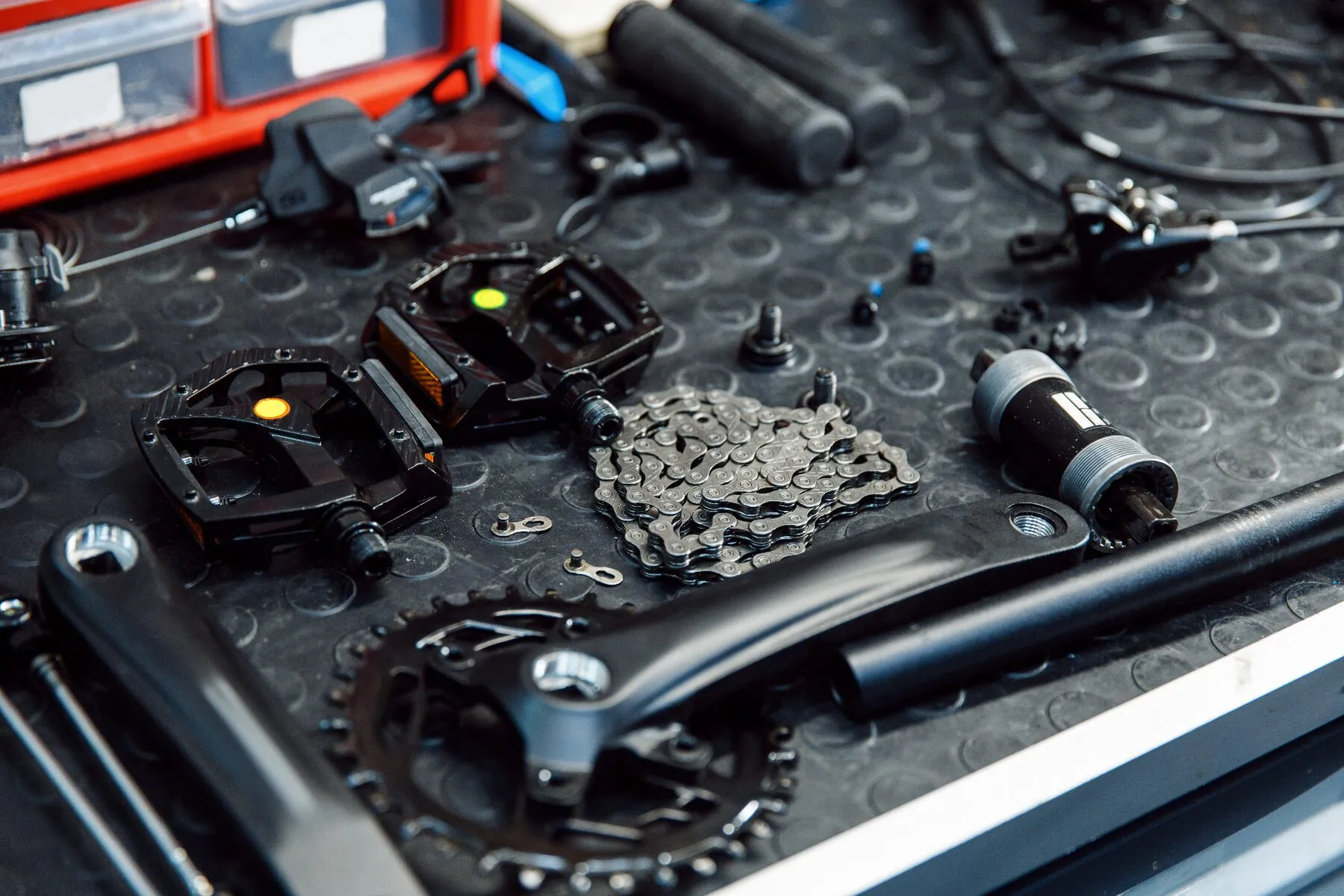
Nylon pedals
- 1Identify each pedal: R (right) and L (left).
- 2Grease the thread and screw it in by hand. Both pedals tighten by turning towards the front of the bike (direction of travel); the left one has a reverse thread, so it turns anticlockwise.
- 3Tighten with a 15 mm spanner to the torque stated in the guide.
FAQS
Will these MTB pedals fit any bike?
They have a standard 9/16" axle, so they fit MTB, gravel, road, BMX, e-bike or folding bikes. They're designed for MTB and demanding gravel: we don't recommend them for the city, the school run or children's bikes, because the wide platform and aggressive pins are uncomfortable for those uses.
What tools do I need to fit them?
A 15 mm spanner (or 6 mm Allen key) for the axle and a 2.5 mm Allen key for the pins. Each pedal is marked L or R on the axle; the left one has a reverse thread.
The pedal feels stiff when I turn it by hand. Is that normal?
Yes. It's an intentional design so you can reposition your foot precisely. Under normal load, when pedalling, that resistance is practically unnoticeable.
Can the pins be removed or replaced?
Yes. The 16 pins on each pedal can be removed one by one with the Allen key. The thread is a fixed length, so their height can't be adjusted.
Are flat pedals or clipless pedals better for MTB?
Flat pedals like these let you put a foot down and reposition it instantly, which builds confidence on technical trails and descents. Clipless pedals add efficiency on long climbs; if you want both, look at our dual-function pedals.
Can they handle water and mud?
The bearing is sealed DU and has a waterproof cap, which protects the axle from water and trail dust.
How much do they weigh and what size are they?
365 g for the complete set of 2 pedals. The platform measures 116 x 113 mm and is 20 mm high (14 mm without pins).
Reflective nylon pedals
- 1Identify each pedal: R (right) and L (left).
- 2Grease the thread and screw it in by hand. Both pedals tighten by turning towards the front of the bike (direction of travel); the left one has a reverse thread, so it turns anticlockwise.
- 3Tighten with a 15 mm spanner to the torque stated in the guide.
FAQS
Will these bike pedals fit any bike?
Yes. They have a standard 9/16" axle, compatible with most bikes — MTB, road, BMX, e-bike, folding, spinning or city. They work just as well on mountain rides as for getting around town.
What are the reflectors for?
The high-visibility side reflectors help others see you in low light, at dawn, at dusk or at night.
What tools do I need to fit them?
A 15 mm pedal spanner or an Allen key (usually 6 or 8 mm), a little grease for the threads and a rag. Each pedal has L or R engraved on the axle; the left one has a reverse thread and tightens anticlockwise.
How do I look after them?
After every ride in mud or rain, and every 2-3 months in normal conditions. A soft-bristle brush for the mud, a damp cloth and a little silicone or PTFE lubricant on the axle.
What size are they?
The platform measures 98 x 108 mm, is 20 mm thick and has 8 anti-slip pins per side.
Dual-function MTB pedals
- 1Identify each pedal: R (right) and L (left).
- 2Grease the thread and screw it in by hand. Both pedals tighten by turning towards the front of the bike (direction of travel); the left one has a reverse thread, so it turns anticlockwise.
- 3Tighten with a 15 mm spanner to the torque stated in the guide.
FAQS
Can I use these clipless pedals with normal shoes?
Yes. One side is flat, with 6 stainless steel anti-slip pins for any everyday shoe. The other is clipless and comes with the cleats included.
Which cleats do they use?
Cleats compatible with Shimano SPD. The set includes the cleats and all their fitting hardware.
Can I adjust the clip-in tension?
Yes. The tension adjusts progressively with the pedal's tension screw, so you can clip in and out safely.
Will they fit my bike?
They have a Cr-Mo steel axle with a universal 9/16" thread, the standard on most mountain bikes and e-bikes: suitable for MTB, e-MTB, enduro and BMX.
How do I fit them?
Identify the right (R) and left (L) pedal: the left one has a reverse thread. Grease the threads, tighten the left one anticlockwise and the right one clockwise, and finish tightening with the Allen key.
What maintenance do they need?
Wipe them with a damp cloth after every ride in mud or rain. Every 2-3 months, or if the rotation feels stiff, apply bearing lubricant. Check the cleats and bolts from time to time.
CNC aluminium pedals L
- 1Identify each pedal: R (right) and L (left).
- 2Grease the thread and screw it in by hand. Both pedals tighten by turning towards the front of the bike (direction of travel); the left one has a reverse thread, so it turns anticlockwise.
- 3Tighten with a 15 mm spanner to the torque stated in the guide.
FAQS
Will these mountain bike pedals fit any bike?
Yes. They have a standard 9/16" thread and are compatible with mountain, road, BMX or city bikes with no need for adapters.
Can I use them as e-bike pedals?
Yes. The 9/16" thread is the usual one on e-MTB and e-bike cranks, and the large 11.8 x 10 cm platform gives a stable footing on long assisted rides.
Can the pins be replaced?
Yes. Each pedal has 14 removable, replaceable pins, so you can swap them when they wear.
Can they handle water and mud?
Yes. The bearing is sealed + DU: it shuts out dust, water and mud so pedalling stays smooth in extreme conditions.
How much do they weigh and what size are they?
380 g the pair. The platform measures 11.8 x 10 cm and is 2.4 cm thick.
CNC aluminium pedals M with reflectors
- 1Identify each pedal: R (right) and L (left).
- 2Grease the thread and screw it in by hand. Both pedals tighten by turning towards the front of the bike (direction of travel); the left one has a reverse thread, so it turns anticlockwise.
- 3Tighten with a 15 mm spanner to the torque stated in the guide.
FAQS
Will these bicycle pedals fit any bike?
Yes. They have a standard 9/16" thread, compatible with most bikes: MTB, gravel, road, e-bike or city.
Can I use them as BMX pedals?
Yes. The 9/16" thread, the Cr-Mo axle and the 12 pins make them a light option for BMX and dirt riding, as well as for the city and the trail.
Will the pins ruin my shoes?
No. They're 12 round-tipped steel pins, removable one by one. They give a firm grip in the wet or in mud without shredding the sole.
Why a medium platform?
At 100 x 95 mm it's more compact and manageable than wide enduro platforms, but it has enough support to keep your foot stable on rough ground.
Can they be seen at night?
Yes. They have integrated reflectors, visible from the front and the side, that boost your visibility in low light. Designed for town riding and the commute.
Can they handle water and mud?
Yes. The DU + sealed bearing system protects the rotation from dust, moisture and mud, and the anti-corrosion anodising resists abrasion and keeps its colour.
How much do they weigh and what size are they?
298 g the pair. The platform measures 100 x 95 mm and is 14 mm thick.
CNC aluminium pedals M
- 1Identify each pedal: R (right) and L (left).
- 2Grease the thread and screw it in by hand. Both pedals tighten by turning towards the front of the bike (direction of travel); the left one has a reverse thread, so it turns anticlockwise.
- 3Tighten with a 15 mm spanner to the torque stated in the guide.
FAQS
Will these flat bike pedals fit any bike?
Yes. They have a standard 9/16" thread, compatible with most bikes on the market: MTB, gravel, road, e-bike, BMX or urban.
Do they have reflectors?
No. This model has no reflectors, for a cleaner, sportier look. If you need them, there's a medium-platform version with reflectors.
Will the pins ruin my shoes?
No. They're 10 rounded, removable steel pins. They give just the right grip without damaging the sole or catching your shins.
How do I fit them?
Straight onto the crank with an Allen key: the thread is the standard 9/16".
Do they need maintenance?
The Cr-Mo axle with DU + sealed bearing protects the inside from dust, mud and moisture: smooth, silent rolling with no maintenance. The anodising won't rust or fade.
How much do they weigh and what size are they?
320 g the pair. The platform measures 97 x 92 mm and is 13 mm thick.
Carbon bottle cage
FAQS
Which bottles fit?
Most bottles on the market, from 7.1 to 7.5 cm in diameter. Don't force larger bottles in, as you could damage the cage or the bottle.
Will it fit my bike?
Yes, as long as the frame has threaded bottle cage bosses. It works on road, MTB, e-bike, city, enduro, BMX and spinning bikes.
How do I fit it?
With the 4 mm hex key included: line the cage up with the bosses, lightly tighten both bolts, adjust the position and tighten firmly without overdoing it. In under 60 seconds.
How much does it weigh?
18 g. It's made of carbon fibre, much lighter than aluminium or plastic.
How do I clean it?
With a damp cloth. Avoid abrasive products that could damage the carbon surface, and check the bolts after long rides or rough terrain.
Is a carbon bottle cage worth it on a road bike?
If you count grams, yes: 18 g, lighter than aluminium or plastic and more resistant to deformation and corrosion. It weighs less than an energy gel and holds the bottle firmly on rough roads.
Side entry aluminium bottle cage
FAQS
Which side does the bottle come out?
The right. The right-hand side entry lets you draw it smoothly on compact frames, full-suspension bikes or with bikepacking bags.
Which bottles fit?
Standard Ø72–76 mm, 500–750 ml cycling bottles. Don't force larger bottles in, as you could damage the cage or the bottle.
Will this bike bottle holder fit my frame?
Yes, as long as it has standard threaded bottle cage bosses (64 ± 5 mm). The elongated slots let you move it up or down to suit the geometry.
How do I fit it?
With the stainless steel bolts and Allen key included: position the cage, set the height with the slots, lightly tighten both bolts and then firmly, without overtightening. Check that the side opening doesn't clash with cables, the shock or the battery.
How do I clean it?
With a damp cloth. Avoid abrasive products that could damage the electroplated finish, and check the bolts after long rides or rough terrain.
Is it a good MTB bottle cage?
Yes. The right-hand side entry lets you draw the bottle on small full-suspension frames where a top-entry cage gets in the way, and the one-piece design holds it rattle-free on technical descents.
Front entry aluminium bottle cage
FAQS
Does it take supermarket water bottles?
Yes. Its special base holds 500–750 ml disposable water bottles, as well as standard 7.1 to 7.5 cm cycling bottles.
What's the advantage of front entry?
You can slide the bottle in and out from the top or the front. It's quicker and easier on compact frames, full-suspension bikes, small bikes or with bikepacking bags.
Will this bike bottle cage fit my bike?
Yes, as long as the frame has standard threaded bottle cage bosses (64 ± 5 mm). It works on MTB, road, gravel, city, folding and static or spinning bikes.
How do I fit it?
With the stainless steel bolts and Allen key included: position the cage, set the height with the elongated slots, lightly tighten both bolts and then firmly, without overtightening.
How do I clean it?
With a damp cloth. Avoid abrasive products that could damage the electroplated finish, and check the bolts after long rides or rough terrain.
Is it a good bottle cage for road bikes?
Yes. At 26 g it adds almost nothing to the bike, the electroplated aluminium resists breakage and corrosion, and the front entry is quick to use on the move, even on compact road frames.
Ceramic jockey wheels 11T
FAQS
Will they fit my rear derailleur?
They suit most 7, 8, 9, 10, 11 and 12-speed rear derailleurs that run 11-tooth jockey wheels. Compatible with Shimano and SRAM, on e-bikes and city bikes too. Before fitting them, check compatibility with your derailleur model.
Do they work with any derailleur bolt?
They include spacers for 4, 5 and 6 mm bolts. On 11 or 12-speed derailleurs you may need a longer bolt than the original.
How do I fit them?
With an Allen key. Remove the bolt holding the jockey wheel to the derailleur, fit the new one with the spacer for your size and tighten firmly but not excessively. Leave enough play for it to spin freely; overtightening increases friction.
What's in the box?
2 eleven-tooth jockey wheels, 2 rings for 4 and 5 mm derailleur bolts, a biodegradable wipe and fitting tips.
How often should I clean them?
Every 300 km or after riding in rain or mud, with degreaser and a small brush. Check the teeth after around 3,000 km of hard use or if you hear noise when shifting.
How much do they weigh and what are the dimensions?
10 g per wheel. 43.4 mm outer diameter and 9.06 mm thick.
Are jockey wheels the same as derailleur pulley wheels?
Yes, it's the same part: the two small toothed wheels in the rear derailleur cage. The upper one guides the chain onto the cassette and the lower one keeps it under tension.
Ceramic jockey wheels 13T
FAQS
Will they fit my rear derailleur?
They suit most rear derailleurs on the market that run 13-tooth jockey wheels, from 7 to 12 speeds. Compatible with Shimano and SRAM. Before fitting them, check compatibility with your derailleur model.
Do they work with any derailleur bolt?
They include spacers for 4, 5 and 6 mm bolts. On 11 or 12-speed derailleurs you may need a longer bolt than the original.
How do I fit them?
With an Allen key. Remove the bolt holding the jockey wheel to the derailleur, fit the new one with the spacer for your size and tighten firmly but not excessively, leaving enough play for the wheel to spin freely.
How often should I clean them?
Every 300 km or after riding in rain or mud, with degreaser and a small brush. Check the teeth after around 3,000 km of hard use or if you hear noise when shifting.
How much do they weigh and what are the dimensions?
12 g per wheel, 52 mm in diameter and 9 mm thick.
Are jockey wheels the same as derailleur pulley wheels?
Yes, it's the same part: the two small toothed wheels in the rear derailleur cage. The upper one guides the chain onto the cassette and the lower one keeps it under tension.
Ceramic jockey wheel 15T / 17T
FAQS
What's the difference between the 15T and the 17T?
Size and weight. The 15T has 15 teeth, a 60 mm diameter and weighs 14 g; the 17T has 17 teeth, a 68 mm diameter and weighs 16 g. Both are CNC 7075 aluminium with a ceramic bearing and stainless steel races.
Will it fit my rear derailleur?
Compatible with Shimano and SRAM: 9 to 12-speed rear derailleurs. Before fitting it, check compatibility with your derailleur model.
What's the advantage of an oversized jockey wheel?
Oversized jockey wheels reduce the angle the chain has to articulate through. That means less wear and saved energy on long rides or high-performance riding.
What if the chain or the pulley rubs the cassette or the derailleur hanger area?
Adjust the rear derailleur's B-tension screw, which sets the gap between the upper pulley and the cassette, until it stops rubbing. A larger pulley needs a little more clearance than the stock one; there's no need to replace the derailleur hanger.
Does it work with any derailleur bolt?
Yes. It includes spacers to adapt it to 4, 5 and 6 mm bolts. It fits with an Allen key and shouldn't be overtightened, so it spins freely.
How often should I clean it?
Every 300 km or after riding in rain or mud, with degreaser and a small brush. Check the teeth after around 3,000 km of hard use or if you hear noise when shifting.
Are jockey wheels the same as derailleur pulley wheels?
Yes, it's the same part: the two small toothed wheels in the rear derailleur cage. The upper one guides the chain onto the cassette and the lower one keeps it under tension.
Jockey wheels 12T + 14T narrow-wide
FAQS
Where does each jockey wheel go?
The 12-tooth wheel is the upper (guide) wheel and the 14-tooth one is the lower (tension) wheel. When fitting them, check they line up properly with the chain.
Will they fit my rear derailleur?
Compatible with Shimano and SRAM: most 9, 10, 11 and 12-speed drivetrains, on road, gravel and MTB. Not compatible with every Campagnolo derailleur because of their specific design. Check your derailleur model first.
Which adaptor do I use for my bolt?
The thick adaptor for a 4 mm bolt, the thin one for 5 mm and none for 6 mm. They come included.
What does the narrow-wide profile do?
Alternating narrow and wide teeth hold the chain better. Shifting is faster and more precise, with less chain drop, vibration and noise.
How do I look after them?
Clean them every 250 km or after riding in rain or mud. Lubricate only the bearings (they come pre-lubricated), sparingly and never the surface of the wheel. Inspect them after around 750 km of hard use.
How much do they weigh and what are the dimensions?
The 12T weighs 10 g and measures 52 mm in diameter; the 14T weighs 11.5 g and measures 60 mm.
Are jockey wheels the same as derailleur pulley wheels?
Yes, it's the same part: the two small toothed wheels in the rear derailleur cage. The upper one guides the chain onto the cassette and the lower one keeps it under tension.
Derailleur hanger extender
FAQS
Is a derailleur extender the same as a rear derailleur hanger?
No. The rear derailleur hanger is the part of the frame the derailleur bolts to. The extender bolts onto that hanger and moves the derailleur back, so you keep your original hanger.
What does a derailleur hanger extender do?
It moves the rear derailleur back so it can reach larger-than-usual sprockets and cassettes. It's essential when converting your bike to 1x.
Which cassettes and derailleurs is it compatible with?
Compatible with Shimano and SRAM derailleurs, for 40T, 42T, 46T and 50T MTB cassettes and 32T and 36T road cassettes, from 8 to 11 speeds.
How do I fit it?
With an Allen key, release the rear derailleur from the hanger. Fit the extender with its tab on the inside, resting on top of the hanger, and bolt the derailleur to the extender with the original bolt. Thread it in by hand first and don't overtighten.
At what angle does it go?
It depends on the offset you need and the hanger model, but it usually ends up at around 45º. Afterwards, check the H and L limit screws and the cable tension.
How much does it weigh and what is it made of?
13 g. It's CNC-machined 7075 aluminium with an anodised finish against rust and corrosion. It measures 45.5 mm overall.
When should I replace it?
If after a knock or crash it's bent, deformed or cracked, if it has corrosion that won't clean off, or if the mating grooves have worn and it no longer holds properly.
Quick release seat clamp
- 1Choose the size by measuring the OUTER diameter of the frame's seat tube, not the seat post or the inside of the frame.
- 2Clean the seat post and frame. If the post is carbon, apply carbon assembly paste (not on aluminium posts).
- 3Fit the clamp with the bevelled side up, the logo readable and the slot opposite the frame's slot (bolt facing backwards).
- 4Allen model: M5×20 bolt (standard) or M5×25 (thick frames or e-bikes). Tighten with a 4 mm Allen key; without other data, do not exceed 5–6 Nm.
- 5QR model: keep the lever accessible and clear of the frame. Close it halfway, adjust the tension and close it firmly without forcing it. If the post slips, increase the tension.
- 6Check that the seat post does not move and check it again after 24 h.
FAQS
Which size do I need?
It depends on the outer diameter of your frame's seat tube (measure the outside of the frame, not the seat post): the 31.8 mm or the 34.9 mm clamp. Compatible seat posts: 27.2 to 28.6 mm with the 31.8 mm clamp and 30.8 to 31.6 mm with the 34.9 mm clamp. Not recommended for seat posts under 27.2 mm.
Do I need tools to fit a quick release seat clamp?
No. You swap it by hand in under 5 minutes. Clean the seat post and frame, apply a thin layer of grease (for a carbon seat post, follow the manufacturer's instructions), position the clamp with the IMPALA logo readable and close the lever.
How tight should it be?
Adjust the thread for a firm 4–6 Nm hold. If the lever is too stiff to close, back the thread off slightly. Then push the saddle down: if it moves, open, adjust and close again.
Will it fit my bike?
Yes, as long as your frame's seat tube measures Ø31.8 or Ø34.9 mm on the outside. It suits mountain, road, city, folding and electric bikes.
How much does it weigh and what is it made of?
36.5 g. CNC-machined 7075 aluminium with a hollow design and an anodised finish against rust and corrosion.
What maintenance does it need?
Clean it now and then with a soft cloth, water and a little mild soap. Apply a thin layer of grease to the seat post every 3–6 months. Replace it if the lever gets hard to close, loses its grip, or you see deformation or a damaged thread.
Allen bolt seat clamp
- 1Choose the size by measuring the OUTER diameter of the frame's seat tube, not the seat post or the inside of the frame.
- 2Clean the seat post and frame. If the post is carbon, apply carbon assembly paste (not on aluminium posts).
- 3Fit the clamp with the bevelled side up, the logo readable and the slot opposite the frame's slot (bolt facing backwards).
- 4Allen model: M5×20 bolt (standard) or M5×25 (thick frames or e-bikes). Tighten with a 4 mm Allen key; without other data, do not exceed 5–6 Nm.
- 5QR model: keep the lever accessible and clear of the frame. Close it halfway, adjust the tension and close it firmly without forcing it. If the post slips, increase the tension.
- 6Check that the seat post does not move and check it again after 24 h.
FAQS
Which seat clamp size do I need?
It depends on the outer diameter of your frame's seat tube (measure the outside of the frame, not the seat post): the 31.8 mm or the 34.9 mm clamp. Compatible seat posts: 27.2 to 28.6 mm with the 31.8 mm clamp and 30.8 to 31.6 mm with the 34.9 mm clamp. Not recommended for seat posts under 27.2 mm.
What tool do I need to fit it?
Just an Allen key. Clean the seat post and frame, apply a thin layer of grease, position the clamp with the IMPALA logo readable and tighten the bolt to a firm 4–6 Nm.
What if my frame is carbon?
Better not to overtighten. Push the saddle down: if it moves, tighten a little more with the Allen key and repeat the test until it holds firm. For a carbon seat post, follow the manufacturer's instructions.
Which bolts does it come with?
An M5 Allen bolt and an extra M5x24 bolt.
How much does it weigh and what is it made of?
28 g. CNC-machined 7075 aluminium with a hollow design and an anodised finish against rust and corrosion.
What maintenance does it need?
Clean it now and then with a soft cloth, water and a little mild soap. Apply a thin layer of grease to the seat post every 3–6 months. Replace it if the thread gets hard to tighten or loosen, it loses its grip, or you see deformation.
Carbon 3D saddle, high firmness
FAQS
Will it fit my seat post?
If your seat post uses a vertical clamp (the bolts clamp the rail from above and below), yes: that covers most road, MTB, gravel and e-bikes. Side-clamp seat posts need 7x9 mm adapters.
Is it a soft saddle?
No. It's a high-firmness performance saddle, like a race saddle. It takes 3–5 rides to adapt and quality padded bib shorts are recommended. If you prefer something less firm, choose the medium-firmness version.
How much does this 3D printed saddle weigh and how big is it?
195 g (±10 g per unit). It measures 250 x 140 mm and has oval 7x9 mm carbon rails.
What torque should I fit it at?
With a torque wrench and a maximum of 6 Nm. The seat post clamp must sit within the rail markings so you don't damage the carbon.
Does it have a central cutout?
Yes. The hollow central channel and honeycomb structure improve ventilation and relieve pressure on the perineal area.
How do I clean it?
With a soft cloth or sponge, warm water and mild soap, every 2–3 weeks or after riding in mud or rain. No solvents, alcohol or abrasive products. Check it once a month.
Carbon 3D saddle, medium firmness
FAQS
Will it fit my seat post?
Yes, if it uses a vertical clamp: the bolts go in from the bottom up and sandwich the rail. That's the standard on most road, MTB, gravel and e-bikes. Side-clamp seat posts need 7x9 mm adapters.
Is a 3D printed bike saddle comfortable from day one?
It's a medium-firmness performance saddle, not a soft leisure saddle. Your body needs 3–5 rides to adapt, and we recommend padded bib shorts for those first rides.
How is it different from the high-firmness version?
The hexagonal padding is medium density, with more flex than the high-firmness version and the same support for a sporty position. Dimensions and oval 7x9 mm rails are the same.
How do I fit it?
With a 5 or 6 mm Allen key (depending on your seat post) and a torque wrench, at 6 Nm maximum, tightening the bolts alternately. The clamp must sit within the rail markings. Check the torque after the first 2–3 rides.
What tilt should I give it?
Level. For long rides, a slight nose-down tilt (±2º) is recommended.
How do I clean it?
With a soft cloth or sponge, warm water and mild soap, every 2–3 weeks or after riding in mud or rain. No solvents, alcohol or abrasive products. Check it once a month.
Aluminium quick release skewer
FAQS
Front or rear quick release skewer?
Check your wheel's axle width: the front skewer is for 100 mm axles and the rear for 135 mm axles. They are sold separately.
What's included?
One bike wheel quick release skewer, in the size you choose.
Will it fit my bike?
Yes, if your wheels use quick release: it is compatible with 26, 27.5 and 29-inch wheels on mountain, road, city, folding and electric bikes.
How do I set the tension?
Slide the skewer through the hub with the lever on the left-hand side and thread on the nut until you feel moderate resistance. You should be able to close the lever with the palm of your hand, firm but without forcing it. If it closes too easily, tighten the nut; if it's too stiff, back it off a little.
How much does it weigh?
50 g front and 55 g rear. CNC-machined aluminium with an anodised finish against rust and corrosion.
Titanium quick release skewers
FAQS
What's in the set?
Two bike quick release skewers: one front for 100 mm axles and one rear for 135 mm axles.
What titanium are they made of?
Grade 5 Ti-6Al-4V CNC titanium, with an anodised finish against rust and corrosion. The pair weighs 46 g.
Will they fit my bike?
Yes, if your wheels use quick release: 100 mm axles at the front and 135 mm at the rear, on 26, 27.5 and 29-inch wheels. For mountain, road, city, folding and electric bikes.
Do they work on a turbo trainer?
Yes. They can also be used as a skewer or adapter for turbo trainers.
How do I set the tension?
Slide the skewer through the hub with the lever on the left-hand side and thread on the nut until you feel moderate resistance. You should be able to close the lever with the palm of your hand, firm but without forcing it, and leave it parallel to the frame. If it closes too easily, tighten the nut; if it's too stiff, back it off a little.
What maintenance do they need?
Clean them after every wet or dusty ride with a soft cloth and a neutral bike cleaner, and dry them well. Replace them if you see wear or deformation on the lever or threads, or if they lose their hold.
Road TPU inner tube 28 g
FAQS
Which tyre sizes does this road bike inner tube fit?
28" (700C) road bikes with 18 to 32C tyres: 18, 23, 25, 28, 30 and 32C. It works, for example, as a road bike inner tube 700 x 23c, 700x25 or 700x28C.
Which valve does it have?
A semi-metal Presta (French) valve with a removable core, in three lengths, 45, 65 and 85 mm, so you can pick the one that suits your rim.
Does it work with disc and rim brakes?
Yes. It's compatible with disc brakes and standard rim brakes.
How do I fit it?
Inflate it to 30 % so it takes shape, without going over 6 PSI, put the valve through the rim and spread the tube inside the tyre without pinching it. Then finish inflating to the recommended pressure for your road tyre (usually between 90 and 120 PSI).
How much does it weigh compared with a rubber tube?
28 g, against the 150 g of a standard rubber tube. It also takes up far less space.
Does it need maintenance?
Check it every 3-6 months or after long rides. To clean it, a damp cloth with water and mild soap is all you need; avoid harsh cleaners.
Are TPU tubes better than butyl road bike inner tubes?
On weight, clearly: 28 g against the 150 g of a standard rubber tube, with less rolling resistance and better puncture resistance. And it packs far smaller as a spare in your saddle bag.
MTB TPU inner tube
FAQS
Which MTB inner tube sizes are there?
Three wheel sizes: 26, 27.5 and 29 MTB inner tubes, for tyres from 1.75 to 2.4" wide. Each in a pack of 1 or 2.
How much does each size weigh?
56 g for the 26", 60 g for the 27.5" and 66 g for the 29", against the 150-200 g of a traditional rubber tube.
Which valve does it have?
A 45 mm semi-metal Presta (French) valve with a removable core, in all three sizes.
Does it work with disc and rim brakes?
Yes. It's compatible with disc brakes and rim brakes.
How do I fit it?
Inflate it to 30 % so it takes shape, without going over 6 PSI, put the valve through the rim and slide the rest of the tube inside the tyre. Refit the tyre and inflate to the recommended pressure.
Are TPU inner tubes good as an MTB spare?
Ideal. At 56 to 66 g they weigh a fraction of a 150-200 g rubber tube and take up far less space, so they disappear into your pack or saddle bag.
Black Seal gravel TPU inner tube
FAQS
Which gravel tyre widths does it fit?
700C (28") wheels with 32, 35, 38, 40 and 42 mm tyres (700x32C to 700x42C). The maximum stretch is 0.3 %.
Does it work with disc brakes and sealant residue?
Yes. It's compatible with disc and rim brakes, and it can be fitted on rims with tubeless sealant residue.
How much does it weigh?
64 g. It saves over 100 g against a butyl tube (150–200 g), and its 0.35 mm wall resists punctures far better than 0.20–0.25 mm TPU tubes.
Does the valve take extenders?
Yes. It's a 65 mm, 100 % metal Presta with a removable core compatible with valve extenders.
How do I fit it?
Pre-inflate the tube to 20–30 % (max. 6 PSI) so it takes shape, insert the valve into the rim, place the tube evenly inside the tyre and finish inflating to the recommended pressure. Don't inflate it outside the tyre or use metal tyre levers.
Why choose Black Seal over ultralight TPU tubes?
Its 0.35 mm wall resists punctures far better than 0.20–0.25 mm TPU tubes, and the double-reinforced valve base protects the joint where TPU usually fails. At 64 g it's still over 100 g lighter than butyl (150–200 g).
Black Seal MTB TPU inner tube
FAQS
Which MTB inner tube sizes are available?
26", 27.5" and 29", all for 1.9 to 2.5" tyres. Each size has its own tube length (1,865, 1,975 and 2,080 mm).
How much does each size weigh?
76 g for the 26", 80 g for the 27.5" and 84 g for the 29". Over 150 g less per wheel than a 235 g butyl tube.
Can I fit it if I run tubeless?
Yes. It's fine over tubeless sealant residue on the rim and compatible with disc and rim brakes. Folded, it's very compact to carry as a spare in your saddle bag.
Is it a Presta valve MTB inner tube?
Yes. A 45 mm Presta in every size, 100 % metal, black anti-corrosion anodised and with a removable core.
How do I fit it?
Pre-inflate the tube to 20–30 % (max. 7 PSI) so it takes shape, insert the valve into the rim, place the tube evenly inside the tyre and finish inflating to the recommended pressure. Don't inflate it outside the tyre or use metal tyre levers.
20-in-1 bike multi-tool
FAQS
Is it a bike multitool with chain breaker and tyre levers?
Yes. It carries a chain breaker and tyre levers as well as the Allen, Torx and spoke keys, so one block covers chain and puncture repairs on the road or the trail.
Which tools does this bike multitool include?
2, 2.5, 3, 4, 5, 6 and 8 mm Allen keys, 5, 8 and 10 mm hex keys, flat and Phillips screwdrivers, Torx 25, chain breaker, 13G, 14G and 15G spoke keys, and M1 and M2 keys compatible with Mavic spokes. It also carries tyre levers.
Which bikes is it for?
Mountain bikes (MTB), road, gravel, e-bikes and city bikes. Use it to adjust derailleurs compatible with Shimano, SRAM and similar systems.
How much does it weigh and how big is it?
117.5 g for the whole kit. It measures 40 x 75 mm, so it fits in your jersey pocket or saddle bag.
Does it rust?
It's made of chromium-vanadium steel (CR-V), with better resistance to rust and corrosion than carbon steel. Even so, clean and dry it after every use.
How do I look after it?
Clean it after every use with a microfibre cloth and, if needed, warm water and mild soap. Dry it thoroughly before storing it and apply a little lubricant to the folding tools, at least once a month or after riding in harsh conditions.
How do I use the chain breaker?
Place the chain in the guide and turn the handle gently to push the pin out or in. Practise at home before you need it in an emergency.
11-in-1 bike tool kit
FAQS
Which chains does the chain breaker work with?
7, 8, 9, 10 and 11-speed chains. It is compatible with Shimano, SRAM, KMC and equivalent chains.
Which tools are included?
2, 2.5, 3, 4, 5 and 6 mm Allen keys, Phillips #2 and flat #5 screwdrivers, Torx T25, spoke key and a chain breaker with integrated lever.
Is this bike tool kit small enough for a jersey pocket?
Yes. It measures 75 x 45 x 12 mm and weighs 147 g. It fits in your jersey pocket, saddle bag or backpack.
Is it a mountain bike tool kit or for road bikes too?
Both. It works as an MTB tool kit and as a road bike tool kit, and also on gravel, triathlon and e-bikes with 7 to 11-speed chains.
Can it handle water and mud?
Yes. The CR-V 6150 steel has an anti-corrosion finish that protects it from damp, rain, sweat and mud.
Cycling gilet
FAQS
Which size should I choose?
The gilet has a slim cut so it doesn't flap in the wind. Check the size chart and, if you're between two sizes or prefer a looser fit, size up.
Is it a cycling gilet for men or a cycling vest for women?
Both. The same cut works as a men's cycling gilet and as a women's cycling vest, in four sizes (S, M, L and XL) and eight colours.
Will it protect me from the rain?
The softshell front blocks the wind and repels water in light rain. It isn't a waterproof garment for heavy rain.
Can I pack the cycling gilet into my jersey?
Yes. It weighs under 150 g and you can fold it into the back pocket of your jersey when you don't need it.
How many pockets does it have?
Three, on the back. Two roomy open ones for a bottle or bigger items, and a central zip pocket for your phone or keys.
How do I wash it?
Machine wash on a delicate cycle (30 °C max) or by hand, with mild detergent and no fabric softener or bleach. Air dry out of direct sunlight. Don't iron it, especially the reflective panels, and don't dry clean it.
Having an issue with your product?
A missing part, something that doesn't fit or doesn't work as it should: tell us and we'll reply within 24-48 working hours.
We have received your enquiry. We'll reply within 24-48 working hours. We've sent a copy to your email.
Delivery, warranty and returns
Still have questions?
Our technical team will answer you at info@impala-pro.com